
Close the gaps before freeze-up
Crack Sealing in Eagan, MN
The least expensive way to slow frost damage on a driveway or parking lot.
- Free on-site estimates
- Itemized written quote: base depth and asphalt thickness spelled out
- Drainage and subgrade checked before any new blacktop
Small Cracks, Big Winters
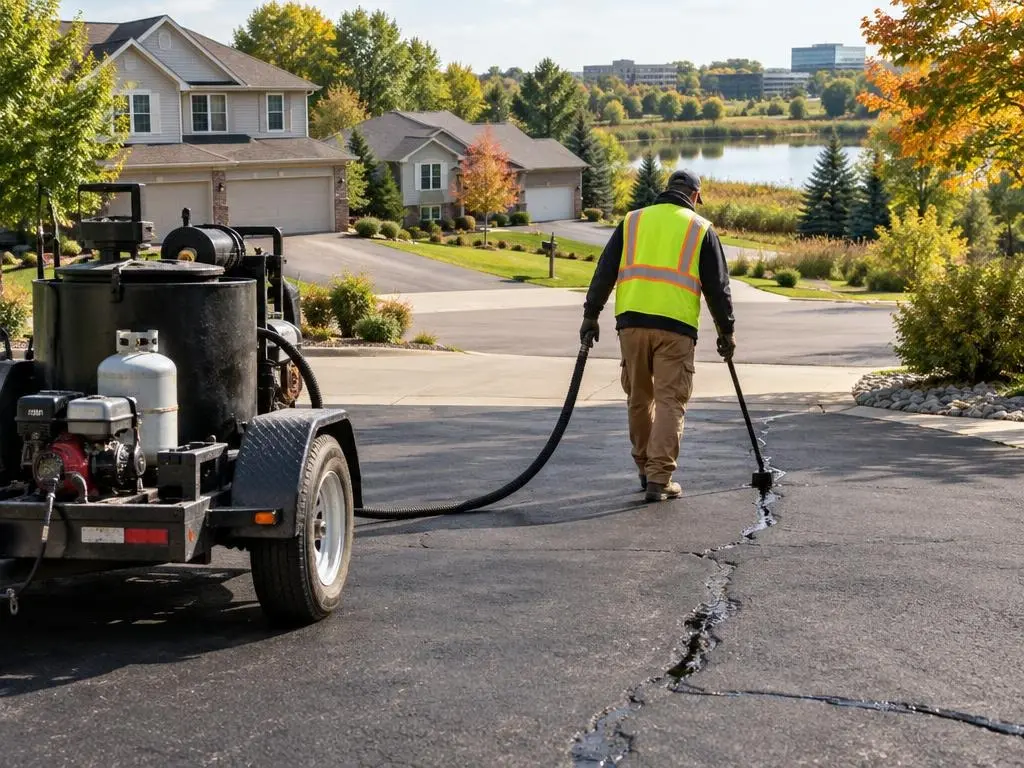
Crack sealing fills open cracks in asphalt with a flexible, hot-applied sealant so water cannot get into the base. It is the cheapest maintenance a driveway or lot can get, and in Minnesota it may be the most important. Every open crack is a path for water. In winter that water freezes and expands, widening the crack. In spring it softens the gravel base. A sealed crack stays a crack instead of becoming a pothole.
Sealing vs. filling
Crack sealing uses a hot, rubberized material that stays flexible and bonds to the crack walls, so it moves as the pavement expands and contracts with temperature. Crack filling is a broader term that includes cheaper, less flexible materials used for wide or inactive cracks. On working cracks, the ones that open in winter and close in summer, hot sealant lasts longer.
Which cracks are worth sealing
- Longitudinal and transverse cracks from about 1/8 inch to about 3/4 inch wide
- Cracks along the joint where a driveway meets the garage slab or curb
- Reflective cracks coming up through an older overlay
Very wide cracks may need a backer or a patch instead. Alligator cracking, a dense web of small cracks, means the base has failed and sealing will not save it; that area needs a patch.
How we do it
Cracks are cleaned out with compressed air or a hot-air lance to remove dirt, vegetation and moisture. Working cracks may be routed into a clean reservoir so the sealant has a uniform channel to grip. Hot sealant is applied, struck off flush or in a slight band, and allowed to set. Most driveways can be driven on the same day.
Timing in Eagan
The best window is late summer through fall, before the first hard freeze, when cracks are partly open and the pavement is dry. Sealing then keeps the most water out over winter. Crack sealing also comes before sealcoating, so the coat goes over closed cracks instead of sinking into open ones.
What sealed cracks look like
A properly sealed crack shows as a neat black band, usually a few inches wide, flush with the surface or slightly raised. Some owners prefer a narrower, flush look on driveways; on parking lots a wider overband adds protection at the crack edges. We tell you which finish we plan to use. After a few seasons, sealed cracks may need touch-ups as the pavement keeps moving, and new cracks will appear as it ages. A yearly or every-other-year check in the fall keeps up with them.
For parking lots and associations
On commercial lots and townhome private drives, crack sealing on a regular cycle stretches the time between overlays. Eagan treats its own streets the same way, using routine maintenance to push pavement life well past the 20 to 25 years a street lasts without it.
What This Covers
Prep and material choice decide how long a sealed crack stays sealed.
Crack cleaning
Debris, weeds and moisture blown out with air or a heat lance.
Routing
A clean channel cut along working cracks for better adhesion.
Hot rubberized sealant
Flexible sealant that moves with the pavement through freeze and thaw.
Joint sealing
Sealing the gap at garage slabs, curbs and patches.
Typical Crack Sealing Costs
| Item | Published range |
|---|---|
| Crack filling (HomeGuide) | $0.50 to $3 per linear ft |
| Small crack and hole repair, driveway (HomeGuide) | $100 to $400 |
| Minimum service fee (HomeGuide) | $100 to $250 |
National ranges from published cost guides, shown for planning only. Twin Cities pricing, access, base condition and season all move the number. The figure on your written estimate is what you pay.
How It Works
1. Survey
We map the cracks and flag any areas that need patching instead.
2. Clean and rout
Cracks are cleaned out and routed where they are working.
3. Seal
Hot sealant is applied and finished flush.
4. Follow-up
We note when a sealcoat would make sense over the sealed surface.
Crack Sealing Questions
When is the best time to seal cracks in Minnesota?
Late summer through fall, before the first hard freeze. The pavement is dry and cracks are partly open, so the sealant fills them well and keeps water out all winter.
How long does crack sealant last?
Hot rubberized sealant in a properly cleaned crack generally lasts several seasons. New cracks keep forming as pavement ages, so plan on checking and touching up every year or two.
Can I just use a store-bought crack filler?
Pourable fillers can help on small cracks, but they are less flexible and tend to pull away as the pavement moves. Hot sealant bonds better and lasts longer on cracks that open and close with the seasons.
Should cracks be sealed before sealcoating?
Yes. Sealcoat is too thin to fill cracks. Seal cracks first, let the sealant set, then coat the surface.
Crack Sealing Service Areas
- Asphalt Paving in Eagan, MN
- Asphalt Paving in Burnsville, MN
- Asphalt Paving in Apple Valley, MN
- Asphalt Paving in Inver Grove Heights, MN
- Asphalt Paving in Mendota Heights, MN
- Asphalt Paving in Lakeville, MN
- Asphalt Paving in Rosemount, MN
- Asphalt Paving in West St. Paul, MN
- Asphalt Paving in South St. Paul, MN
- Asphalt Paving in Savage, MN
- Asphalt Paving in Prior Lake, MN
- Asphalt Paving in Bloomington, MN
- Asphalt Paving in Richfield, MN
- Asphalt Paving in Farmington, MN
- Asphalt Paving in Hastings, MN
- Asphalt Paving in Edina, MN
- Asphalt Paving in Shakopee, MN
- Asphalt Paving in Cottage Grove, MN
- Asphalt Paving in Woodbury, MN
- Asphalt Paving in Saint Paul, MN
Get a Crack Sealing Estimate
Book crack sealing before freeze-up. Free estimates in Eagan.